Qualifying Program for
Certified Emotion-Focused Therapy (EFT) Practitioners
2007-2009
 Objectives
-
To learn to identify different types of emotional expression
-
To learn when to regulate and when to access emotion
-
To learn how to intervene differentially with emotion
-
To learn how to access adaptive emotions to produce change
-
To learn to facilitate emotional processing, to resolve self-critical splits and unfinished business
-
To deal with blocks and impasses in intervention
-
To understand the phenomenon of marital distress in the context of emotion and its role in intimacy and attachment
-
To learn to differentiate between adaptive and reactive emotions in couples
-
To learn to help couples access and work with their adaptive emotions
-
To identify specific interventions to help couples externalize their problem as a negative interactional cycle, to transform problematic affect states and access more intimate states
-
To foster a more secure emotional bond between partners
-
To understand and incorporate EFT theory in practice
-
To become competent therapists in using the EFT model
Organizers
-
The Hong Kong Catholic Marriage Advisory Council
The HKCMAC is a voluntary welfare services organization established in 1965. The aim is to provide professional services for the promotion of happy marriages and responsible parenthood. The HKCMAC has been providing quality counselling service for individuals, couples and groups for nearly 40 years. It has trained up quite a number of competent professional counsellors and mediators over the past years. It keeps on taking a leading role in providing professional training in the field.
-
EFT Training Organisation, Toronto, Canada
The EFT Training Organisation provides training in Emotion-Focused Therapy (EFT) by Prof. Greenberg of York University and colleagues from a variety of institutions. It is based in Toronto in Canada and provides a variety of different forms of training in Emotion-Focused Therapy and Emotionally Focused Couples Therapy. A number of different levels of four day training programs are run through the Applied Psychology Institute in Toronto (www.emotionfocusedtherapy.org). In addition, different forms of training are offered in North America and internationally ranging from one day workshops on different applications of EFT to intensive four day training workshops. The mission of this organization is to provide high quality training in EFT to mental health professionals and people in the helping professions.
Principal Trainer
Professor Leslie Greenberg, Ph.D.
Dr. Greenberg is Professor of Psychology at York University in Toronto,
Ontario. He is the Director of the York University Psychotherapy Research
Clinic and one of the leading authorities on working with emotions in
psychotherapy and the developer of emotion-focused therapy. He has with
colleagues authored the major texts on Emotion-focused approaches to
treatment of individuals and couples from the original work on Emotion in
Psychotherapy and Emotionally Focused Couples Therapy in the 1980's to his
latest books on Emotion-Focused Therapy: Coaching Clients to Work Through
Emotion and Emotion-Focused Therapy of Depression. Dr.
Greenberg is a
founding member of the Society of the Exploration of Psychotherapy
Integration (SEPI) and a past President of the Society for Psychotherapy
Research (SPR). He received the 2004 Distinguished Research Career Award of
the Society for Psychotherapy Research: An International Interdisciplinary
Society. He is on the editorial board of many psychotherapy journals,
including the Journal of Psychotherapy Integration and the Journal of
Marital and Family Therapy. Practitioners from diverse camps including
cognitive-behavioral, interpersonal, psychodynamic and solution-focused
recognize Dr. Greenberg's integrative work. He conducts private practice for
individuals and couples and trains people in experiential and
emotion-focused approaches.
Dr. Greenberg uses a combination of lectures, videotape demonstrations, live
role plays, supervised practice periods, and focused question & answer
periods to maximize skill acquisition. His teaching is practical and
specific. Workshop participants leave with techniques they can readily
integrate into their everyday practices.
TrainersDr. Wanda Malcolm, Ph.D., C. Psych.
Dr. Wanda Malcolm is a registered psychologist. She has over 10 years experience as a therapist and takes an emotion-focused approach in her work with individuals and couples. She did her undergraduate studies at Lakehead and York Universities. Her M.A. was completed at the University of Toronto's Ontario Institute for Studies in Education after which she returned to York to earn a PhD in clinical psychology.
Dr. Malcolm served as co-investigator on Dr. Les Greenberg's Forgiveness Research Project from 2001 until 2004, and continues to be involved as a member of his psychotherapy research team at York University. She is currently an adjunct member of faculty in the Psychology Department at Brock University. Her clinical research is aimed at improving therapists' understanding of what needs to happen in psychotherapy to be meaningful and lasting improvements in clients' emotional and psychological wellbeing.Dr. Serine Warwar, Ph.D., C. Psych.
Dr. Serine Warwar is a psychologist in patient programs at St. John's Rehab Hospital. She provides inpatient and outpatient assessment and treatment for psychological disorders, such as post-traumatic stress disorder, depression, and anxiety resulting from serious injuries such as amputations, burns, and stroke. Most recently, Dr. Warwar was involved in treatment and research at the Arthur Sommer Rotenberg Chair in Suicide Studies, University of Toronto, with chronically suicidal patients with borderline personality disorder. Dr. Warwar has over 10 years of experience doing EFT and has applied EFT to different clinical populations including domestically violent men in prison and suicidal individuals with borderline personality disorder. In addition, she has a private practice in EFT with individuals and couples and conducts EFT skills training with professionals. She was also the research and treatment coordinator at the York University Psychotherapy Research Clinic working on two psychotherapy research studies examining forgiveness in individuals and couples. One of Dr. Warwar's primary areas of interest in psychotherapy research is relating process to outcome variables in order to identify key therapeutic variables that facilitate change. She completed her M.A. and Ph.D. in Clinical Psychology at York University.Mrs. Maria Kong
Maria Kong is a renowned and experienced marital clinician and educator in the counselling field. She has been working with the HKCMAC for over 25 years. She received a MSW from the Chinese University of Hong Kong and has received advanced training on different clinical therapeutic approaches. Her interests and specialties include marital therapy and education, family mediation, sex therapy, and woman development. She is also a part-time lecturer for the Master of Counselling Program at the City University of Hong Kong.
Since 2002, Mrs Kong has been learning EFT from Professor Leslie S. Greenberg and other EFT practitioners in Canada and Hong Kong. Currently, she is under Professor Leslie S. Greenberg's intensive supervision on EFT practice. Her scope of profession has widened to include emotion regulation, transformation of self-integration, distressful relationship and relationship reconnection.
Facilitators
Experienced counsellors of HKCMAC will supervise all trainees, in small groups of 6, during the Practicum Training.
Course Curriculum
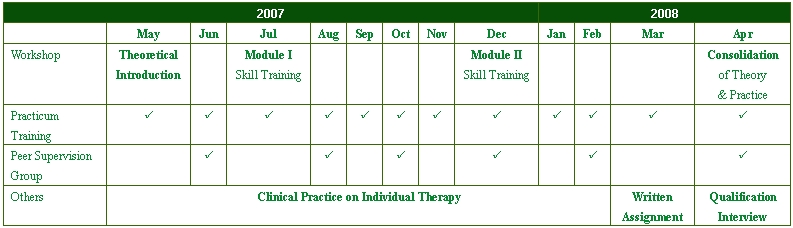
Year 2 - Couple
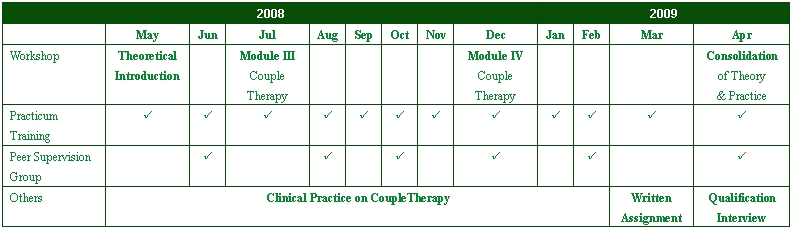
Therapy
Workshops
Year 1 Individual Therapy
4-5 May 2007
2-day workshop on Theoretical Introduction (Individual Therapy)
by Professor Greenberg & Dr. MalcolmEmotion
• Emotion theory, assessment and principles of change
Empathy, Validation and Focusing on Feeling
• Creating an alliance
• Empathic attunement
• Validation
• Emotional Exploration
• Evocation
• Conjecture
Process Formulation, Developing a Collaborative Focus
• Identifying generating conditions
• Symbolizing internal experience
• Intrapersonal & interpersonal determinants
• Idiosyncratic determinants
• Accurate process-oriented formulations
9-11 July 2007
3-day workshop on Module I Skill Training
by Dr. Warwar & Mrs. Maria KongEvocation, Arousal and Exploration, Part I
• Concentration methods
• Evocation methods
• Enactive methods
• Models of change processes
Evocation, Arousal and Exploration, Part II
• Focusing
• Evocative unfolding
• Two chair dialogue and splits
• Empty chair dialogue
Accessing Primary Adaptive Emotions & Core Maladaptive Schemes
• Accessing primary emotions
• Accessing core dysfunctional emotion schemes
• Allowing, accepting and owning
Restructuring Core Schemes
• Supporting the emergence of primary needs
• Tapping positive emotional resources
• Challenging core maladaptive beliefs with newly accessed needs and emotions
• Letting go of unmet needs
• Provision of new experiences
Self-Soothing and Meaning Creation
• Supporting a self-affirming stance
• Promoting new narrative constructions
• Specific tools for working with anger, sadness, fear and shame
Skill Training & Applications
• Depression
• Post-traumatic stress disorder
• Addictions
• Contraindications
10-12 December 2007
3-day workshop on Module II Skill Training
by Professor Greenberg & Mrs. Maria KongAdvanced Empathy
• The moment by moment tracking of affect
• Empathic exploration and conjecture
• Empathic evocation
Marker Identification
• Issues in identifying markers of splits and unfinished business
• Additional markers: self-interruption, vulnerability, trauma, alliance ruptures
Advanced Work with Two-Chair Dialogue: The Process
• Sensing the opposed forces
• Following and leading
• The role of the "other person" in two-chair dialogue
• Dealing with collapsing and impasses
• Self-interruptive dialogues
• Self-soothing dialogues
Advanced Work with Unfinished Business: The Process
• Evocation of emotion
• The interruptive process
• The letting go process
• Forgiveness
• Imaginal restructuring
23 April 2008
Half-day workshop on Consolidation of Theory and Practice (Individual Therapy)
by Professor Greenberg & Mrs. Maria KongAdvanced Practice & Supervision
• Difficult clients and processes
• Applications to specific populations and types of problems
• Supervision
Year 2 Couple Therapy
24-25 April 2008
2-day workshop on Theoretical Introduction (Couple Therapy)
by Professor Greenberg & Dr. MalcolmOverview of the Couple Therapy
• Attachment motivation
• Identity motivation
The Rationale for Focusing on Emotions in Couple Therapy
• Emotion accessing
• Interactional skills
21-23 July 2008
3-day workshop on Module III Couple Therapy
by Dr. Malcolm & Mrs. Maria KongSteps in the EFCT Framework
• Forming an alliance and identifying core issues
• Identifying maladaptive cycles
• Accessing underlying feelings
• Changing interactions
• Consolidation and Integration
Therapists Skills & Intervention
• Accessing and repossessing emotions
• Restructuring interactions
• Consolidating change
• Anticipating relapse and scheduling booster sessions10-12 December 2008
3-day workshop on Module IV Couple Therapy
by Dr. Greenberg & Mrs. Maria KongAttachment Related Cycles
• Accessing underlying attachment related emotions
• Softening and empathic cycles
Dominance Related Cycles
• Accessing underlying identity related emotions
• Assertion and validation cycles
Emotion Accessing Skills in Couples
• Dealing with blocks
• Focusing
• Heightening
20 April 2009
Half-day workshop on Consolidation of Theory and Practice (Couple Therapy)
by Dr. Greenberg & Mrs. Maria KongAdvanced Practice & Supervision
• Difficult clients and processes
• Indications and Contraindications
• Supervision
Practicum Training
The practicum training will provide
in-depth skills
training to all trainees. Trainees will form small learning groups of 3 or 4
and meet for at least 12 meetings over the year for three hours each to view
practice video and to practice skills.
Two small learning groups are to form one combined peer supervision group.
Each supervision group will have at least 6 bi-monthly meetings of three
hours each over the year. Trainees are required to present their clinical
practice in the supervision group.
Clinical Practice
Trainees are required to apply the EFT model in working with clients. They are encouraged to videotape all practice sessions, with clients' consent, for self-evaluation and supervision. If no videotape can be presented, the trainees are required to do a piece of work with other trainees as clients.
Written Assignment
Trainees are required to complete one written assignment, from 4000 to 5000 words, on the application of EFT in individual therapy and/or couple therapy.
Qualification Interview
Trainees are required to attend a 1-hour interview and to present a video on their own clinical practice to the Trainers for assessment. On passing this qualifying examination of their practice, the trainees will be certified.
Additional Individual Supervision Available after Each Module
Additional individual consultation or supervision will be available, if desired. Manner and fee of this consultation or supervision to be arranged individually with trainers.
Medium of Instruction
English for all workshops and the graduation
interview
Cantonese for all practicum training and clinical practice
Only one peer supervision group would be conducted in English
Venues
-
For Workshops
To be arranged
-
For Peer Supervision Groups
Rm. 101, Low Block, Grand Millennium Plaza, 181 Queen's Road Central, HK.
-
For Practicum Training and Clinical Practice
As arranged by trainees